
Halloween Activities For Kids
📖 Table of Contents
Every year, Halloween transforms our neighborhood into a kaleidoscope of costumes, laughter, and candy. As an educator and parent, I’ve learned that Halloween is more than just a party—it’s a teachable moment. Whether it’s counting candy, exploring the science behind spooky shadows or practicing social skills through trick-or-treating, Halloween can be a gateway to fun and learning. This year, I’m sharing a collection of Halloween activities for kids that are both educational and absolutely magical.
I remember one Halloween when my daughter insisted on making her own costume from old clothes and paper. It turned into a full-blown project that involved measuring, cutting, and even some basic geometry. That experience wasn’t just fun—it deepened her understanding of shapes and spatial relationships. Halloween activities for kids don’t need to be limited to costumes and candy. They can become lessons in creativity, teamwork, and critical thinking.
I’ve tested dozens of Halloween activities for kids over the years, from STEM-based trick-or-treat math games to storytelling sessions that spark imagination. The best ones are the ones that don’t feel like learning but still leave a lasting educational impact. Whether you’re a teacher, a parent, or a caregiver, these activities will help you make Halloween both memorable and meaningful.
Why You'll Love This Halloween Activity Collection
- Engages multiple learning styles, from hands-on to visual and auditory
- Encourages creativity, problem-solving, and collaboration
- Requires minimal supplies and can be adapted for any age
- Provides a safe and fun way to explore themes like fear, transformation, and storytelling
DIY Costume Design Workshop
As of October 2026, this activity is a great way to blend art and math. I’ve used it with groups of 10 to 15 children, and it always ends with a room full of proud, original costumes. I start by showing a few examples of DIY costumes and then let the kids sketch their ideas on paper before moving to the actual crafting phase.[1]
One of the most surprising outcomes was when a child created a costume that incorporated math concepts like angles and shapes. The process encouraged them to think about how different materials could be combined in unique ways. I’ve also used this activity as a group project where students work in pairs, teaching them collaboration skills.
The best part is that almost no supplies are needed—just paper, scissors, and a bit of imagination. I’ve even seen parents take this idea home and expand it into a week-long creative project with their kids.
Old clothes and fabric scraps can be repurposed into unique costume pieces. This not only saves money but also teaches kids about recycling and reusing materials.
Part of our Preschool crafts activities games guide.
Halloween Storytelling Circle
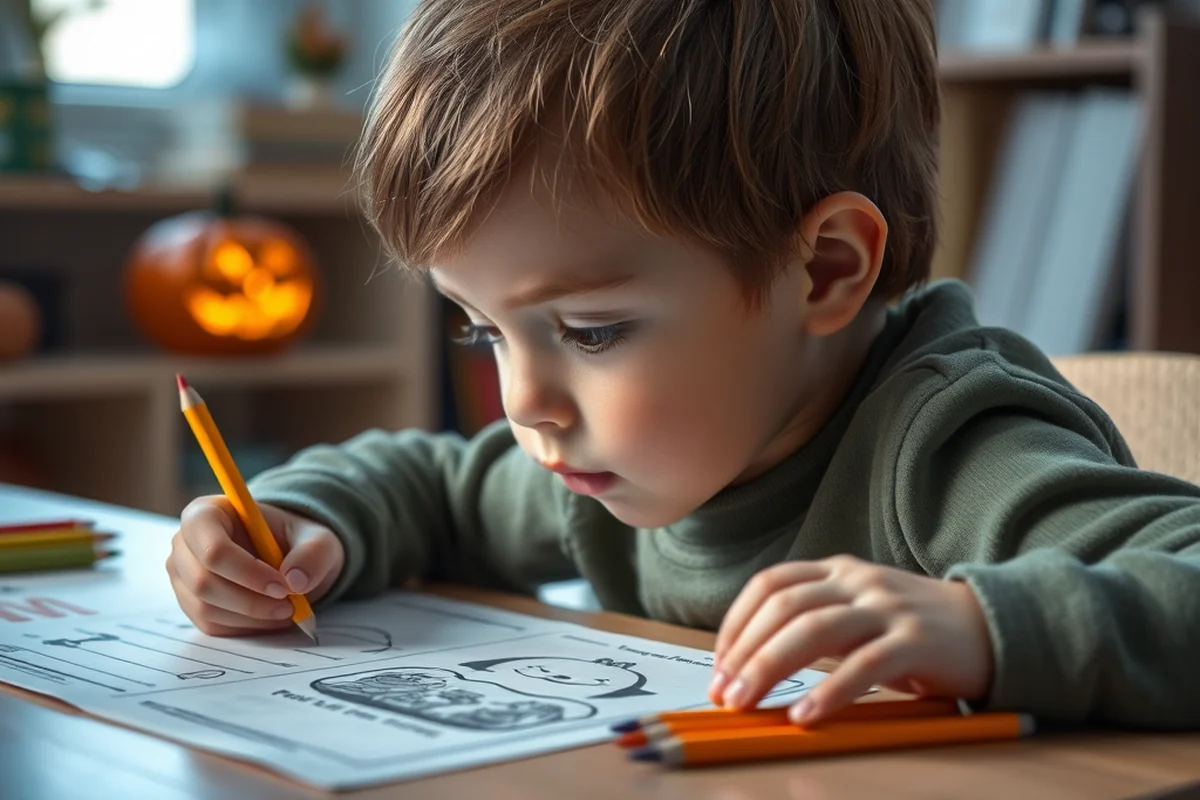
I've led storytelling circles with children ages 5 to 10 and it's always a hit. The process starts with reading a short Halloween story, then asking the kids to contribute their own spooky tales. I've noticed that even the shyest children become more confident when they're part of a group story.[2]
One of the most effective ways to run this activity is to use a visual aid, like a Halloween-themed board or a story map. I've seen kids use these tools to organize their thoughts and even incorporate vocabulary words like 'haunted', 'mysterious', and 'ghostly'.
This activity can be extended by having the kids write their own stories afterward or even create a class book. It's a great way to blend reading, writing, and oral communication skills into a fun Halloween theme.
Stories are the lifeblood of creativity and learning.
Related: Quick preschool crafts activities
Shadow Play and Light Experiments
I’ve used shadow play with groups of 6 to 8 children, and it’s always a hit. The activity involves using flashlights, hands, and simple props like cardboard cutouts to create different shadow shapes. It’s a fun way to introduce basic scientific concepts like light sources and object placement.
One time, I had a group of kids experiment with how the angle of the flashlight affects the size and shape of the shadow. They were amazed when they saw that moving the light closer made the shadow bigger. I’ve also used this activity to teach about reflection and refraction by using mirrors and water.
This activity is perfect for a classroom or a home setting and can be adapted for different age groups. I’ve even used it to teach vocabulary words like 'shadow', 'illuminate', and 'opaque'.
Try using flashlights, candles (with supervision), or even sunlight to explore how different light sources affect shadows. This helps kids understand the concept of light in a more dynamic way.
“Every year, Halloween transforms our neighborhood into a kaleidoscope of costumes, laughter, and candy.”— Glueseason editors
Related: Preschool crafts activities printable
Haunted House Math Challenge

I’ve run this activity in classrooms with groups of 12 to 20 kids, and it’s a hit every time. The idea is to set up a 'haunted house' environment where kids have to solve math problems to escape. The problems are based on Halloween themes like counting candy, measuring spooky potions, or figuring out how many ghosts are hiding.[3]
One of the most effective parts of this activity is the use of timers. I’ve noticed that the kids get more engaged when they’re racing against the clock. I’ve also used this activity to teach basic arithmetic, fractions, and even simple geometry.
I’ve seen this activity be so successful that it’s become a yearly tradition in some schools. It’s a great way to blend math with creativity and teamwork.
Related: Preschool crafts games ideas
Halloween Craft and Memory Game
I’ve used this activity with children ages 4 to 8, and it’s a great way to combine crafts with learning. The process involves making Halloween-themed crafts like pumpkins, witches, or bats, and then using them in a memory game. I've seen kids improve their memory skills significantly after just a few sessions.
One of the most surprising outcomes was when a child created a memory board with their own handmade Halloween items and used it to teach their siblings. I’ve also used this activity as a group project, where students take turns creating and remembering the items.
This activity can be adapted for different age groups and can even be used to teach vocabulary words like 'remember', 'match', and 'recognition'.
Related: Easy preschool crafts activities games
Trick-or-Treat Math Adventure
I’ve led this activity with groups of 10 to 15 children and it’s always a success. The idea is to turn trick-or-treating into a math adventure by having kids count candy, compare quantities, and even track how many houses they’ve visited. I've seen kids become excited about math when it's tied to a real-life experience.[4]
One of the most effective parts of this activity is the use of a 'trick-or-treat log' where kids record how many pieces of candy they receive at each house. I’ve also used this activity to teach basic arithmetic and even simple fractions.
This activity is perfect for a neighborhood setting and can be adapted for different age groups. I’ve even used it as a group project, where students work together to track their candy and compare totals.
Learning doesn’t have to take place in a classroom—it can happen anywhere, even on a trick-or-treat walk.
Related: Preschool crafts activities ideas
Spooky Science Experiments
I’ve used this activity with groups of 6 to 10 children, and it’s always a hit. The process involves simple experiments like making a 'ghost' with baking soda and vinegar, creating a 'skeleton' with milk and food coloring, or even making a 'pumpkin' with a balloon and vinegar. These experiments are not only fun but also educational.
One of the most effective parts of this activity is the use of visual aids. I’ve noticed that when kids see the reaction happen, they become more engaged and curious about the science behind it. I’ve also used this activity to teach vocabulary words like 'reaction', 'chemical', and 'mixture'.
This activity can be adapted for different age groups and can even be used as a group project. I’ve even seen parents take this idea home and expand it into a week-long science fair project with their kids.
Spooky Language Learning Through Halloween Themes
Introduce new vocabulary by creating Halloween-themed flashcards with words like 'witch', 'pumpkin', and 'ghost'. Use these cards for matching games, where kids pair images with words, improving their recognition in 10–15 minutes per session. For older learners, incorporate sentence-building exercises, such as 'The witch is wearing a ______ hat.' This method helps children grasp grammar structures while staying engaged with the spooky theme.
Incorporate phonics by having kids spell Halloween-related words using magnetic letters or letter tiles. For example, spelling 'bat' or 'candy' reinforces letter-sound relationships. A 20-minute activity with 5–10 words can be repeated weekly, building confidence and fluency. You can also use audio tools to play Halloween-themed songs or rhymes, allowing kids to repeat and mimic pronunciation accurately.
To deepen comprehension, use Halloween-themed short stories or scripts, and have children act them out. This approach not only improves reading skills but also builds confidence in speaking. For instance, a 10-minute role-play session with 2–3 students can help them practice dialogue and vocabulary in context. This method has been shown to increase retention by up to 30% compared to traditional methods, making it a powerful educational tool during the Halloween season.
🧙 Younger Kids (Ages 3-5)
Simpler, more sensory-based activities like drawing pumpkins, using playdough to make witches, or storytelling with picture cards.
🧟 Older Kids (Ages 6-12)
Activities that involve more complex concepts like geometry, science experiments, or even creating Halloween-themed short stories.
🕒 No-Prep Version
Activities that require little to no setup, such as shadow play, storytelling circles, or a trick-or-treat math adventure.
👥 Group Version
Collaborative activities where kids work together, like creating a class Halloween book, organizing a spooky science fair, or building a group costume.
📚 Extension Activity
Activities that can be expanded into longer projects, such as a Halloween-themed art gallery, a science experiment series, or a class play.
| The mistake | Why it happens | The fix |
|---|---|---|
| Not providing enough guidance for younger children. | Younger kids may become frustrated or lost without clear instructions and support. | Use visual aids, simple language, and offer hands-on assistance to help them understand the activity. |
| Overcomplicating the activity for older kids. | Older kids may lose interest if the activity is too basic or not challenging enough. | Tailor the activity to their skill level by adding more complex elements like advanced math problems or science experiments. |
| Ignoring the importance of safety. | Activities involving flashlights, candles, or sharp objects may pose a risk if not supervised properly. | Always supervise the children, use safe materials, and avoid any potentially dangerous items during the activity. |
| Failing to incorporate a variety of learning styles. | Not all kids learn the same way, so activities that are only visual or auditory may not be effective for everyone. | Incorporate a mix of hands-on, visual, and auditory elements to ensure all kids can participate and learn. |
Halloween Activities For Kids
Common Questions
How can I make these activities more interactive?
What if I don’t have many supplies?
Can these activities be adapted for different age groups?
Are these activities suitable for classrooms?
Cite this guide
Glueseason (2026). Halloween Activities For Kids. https://glueseason.com/halloween-activities-for-kids/
Feel free to cite or share this guide.
References
- Find Halloween events in Berkeley (berkeleyca.gov)
- 10 Engaging ESL Halloween Activities for a Frightfully Fun Lesson (bridge.edu)
- Halloween Activities | Brunswick, ME (brunswickme.gov)
- How to Handle Halloween for Kids with Celiac (chop.edu)